


 |
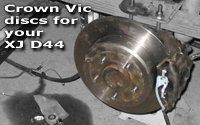
Crown Vic discs for your XJ D44 |
Article by Kevin Hamilton.
Introduction
Despite the fact that my Dana 44 had larger drums than the Dana 35 it had replaced, braking power still wasn’t up to par. For obvious reasons when I had swapped on some 33”s and steel rims, my braking suffered, so I set out to do something about it. After talking with a friend of mine, cherokeekid, I learned that the rear discs from a ’94 or so Crown Vic would work with some simple modification, I jumped off the computer and headed down the local junkyard.
Just my luck, the yard had a junked Crown Vic with the majority of the parts I would need to do my conversion. The parts needed for the conversion are as follows:
|
Part Part #
|
Vendor
|
Price
|
Quantity
|
Total
|
Vehicle Year
|
Comments
|
| Axle bearings BR10 | Napa | N/A | 2 | N/A | Jeep Cherokee 1987 | |
| Oil Seals 18731 | Napa | N/A | 2 | N/A | Jeep Cherokee 1987 | |
| Retainer Plates 5083678AA | Dealership | ~$3.00 | 2 | $6.00 | Jeep Wrangler Rubicon 2003+ | Could be substituted for a custom made spacer |
| Soft Lines | Junkyard | N/A | 2 | N/A | Ford Crown Victoria 1994 | |
| Caliper Mounting Brackets | Junkyard | N/A | 2 | N/A | Ford Crown Victoria 1994 | |
| Calipers | Junkyard | N/A | 2 | $100 | Ford Crown Victoria 1994 | Price is the total for everything I grabbed from the junk yard |
| Rotors UTS 4886238 | Napa | $26.99 | 2 | $53.98 | Ford Crown Victoria 1994 | |
| Brake Fitting Plug | Napa | N/A | 1 | N/A | Universal |
Unfortunately I am not able to provide a complete price list because of a few reasons. Firstly, I opted to get remanufactured calipers, new pads and rotors because the ones from the junkyard weren’t the greatest shape. I also get a discount on my parts and I go solely to Napa so if you shop around your prices will vary. I imagine if you are able to get all the parts in good shape from the junkyard including new bearings and seals you should be able to do the entire swap for under $200.
As for tools you don’t need much, I would say the average guy has most of the tools needed in his garage with the exception of a shop press to remove and press on the new wheel bearings if needed. Besides that you’ll need a grinder, various sockets and extensions, and something to enlarge the center holes in both the rotors and the caliper bracket. I found a grinder attachment for a die grinder or a Dremel works great for that part of the swap.
The Install
The first thing you’re gonna want to do is jack up Jeep and place it securely on jack strands and remove the wheels. Just to be safe while you’re at it you should probably block of the tires as you’re not going to have any the parking brake or e-brake holding the vehicle in place. Once you’ve got that squared away, remove the drums and the 4 nuts holding both the axle retainer plate and the drum backing plate onto the housing.
From here you’ll need to pull the axle shafts. If your shafts are as stubborn as mine were, a slide hammer can come in very handy here. If you’re not lucky enough to have a slide hammer, put the drum on backwards with some lightly tightened lugs and use it as a make shift slide hammer. As long as you’re down there, have one of your handy friends grab you a flare wrench and disconnect the brake lines and pull out both the drum backing plate as well as the old bearing race.
Then you’ll want to use your shop press to remove your old bearings and retainer plates. I personally didn’t have the tools so I had to bring mine to a local shop. If you’re lucky, you’ll get a “cash discount” and they’ll do it pretty cheap. From here, grab one of your old retainer plates and one of the new Rubicon ones and secure them together with a c-clamp hopefully getting the center holes as close together as possible. Based on your old retainer plate, enlarge/drill holes in the new retainer plates as necessary.
) |
) |
Next you’re gonna want to press your new retainer plates, bearing and seals onto the axle shaft. If your bearings are in good shape you can cut the old retainers off and notch the new ones to fit over the axle shaft. Make sure that the lip of the plate faces the splined part of the shaft otherwise they won’t work right. NOTE: Make sure you or whoever is pressing on the bearings presses them on the right way. The shop I took them to accidentally did that as well as another guy I know who did this swap. The races and the bearing are stuck together very tightly with some grease so don’t get confused!
) |
) |
Now that you’ve got your axle shafts squared away you’re gonna need to enlarge center holes on both the rotors and the caliper mounting bracket. This is where the Dremel/die grinder attachment comes into play. If I had to guess, I’d say you shave off about 1/16” off the caliper bracket and about 1/8” off the rotor. The easiest way to do it is just to grind and test fit and see how it’s coming along. Just to be safe, it’s probably best to do the grinding of the caliper mounting bracket off of the vehicle. That way you save yourself the trouble of having to clean the metal shavings from the axle tube and you also don’t run the risk of possibly damaging the race.
Once you’ve finished that, take your caliper bracket and put it the driver’s side so that the caliper is nearest the rear of the car. Here you’re gonna want to mark the plate where it will not sit flush so that you know where to grind. I ended up using a silver sharpie which stood out well. Now bust out the grinder wheel and take off part of the bracket till it will finally sit flush. Do the same thing for the passenger side except this time the caliper is going to sit towards the front of the Jeep. After you’ve finished that, use a brass punch and lightly tap the new races into place if you are replacing your old bearings. With the brackets now sitting flush, install them to the axle tube, slide in the axle shafts and bolt down the new retainer plates. Don’t worry though, you’re almost finished, whew!
) |
) |
Now install your new rotors with the enlarged hole. If you have yet to enlarge it, you’ll soon find out why, the rotor won’t fit over the hub on the axle and you can’t seat the rotor right. Go grab your Allen wrenches and your calipers and get back to work. Putting some silicone glide on the mounting bolts wouldn’t hurt as they’ve probably been sitting in the junkyard for a while now.
) |
) |
As for mounting the soft lines, I personally needed something quick and cheap. I got some large metal hose clamps and clamped a shortened version of the soft line mounting bracket onto the axle housing and it has seemed to work fine. You can also weld a bolt the axle tube as an attachment point, using the CV soft lines (short side explorer ones work well also). Cutting the factory hard lines down to the proper length will provide the cleanest install in this situation. Put the plug into the drivers side soft line end (as it has two, the hard line on the CV starts there and goes from the driver’s side caliper to the passenger’s side unlike the XJ) and hook up your brake lines. Now grab a buddy or a pair of speed bleeders like I did and bleed your brakes and you’re set!
Conclusion
After everything was said and done, I was really pleased with how the disc swap turned out. Although I definitely spent more than $200 as I opted to get new parts when possible it was still worth the money I had invested. The new set up stops way better with 33”s than my Jeep ever did even with 31”s and drums. Although I haven’t had a chance to test the full capabilities of them due to some driveshaft issues, I think I could lock up my 33”s on dry pavement if not, I could get very close. All in all, the swap was relatively easily, inexpensive and yielded great results!
And now I will tell you about the downsides to the newly swapped disc brakes. Although it brakes great and I don’t have a spongy pedal, the rear still doesn’t have quite the stopping power it should in comparison to the front at times. I’ve been looking into swapping in a ZJ proportioning valve which should hopefully eliminate that. Another possibility is to remove the o-ring on the proportioning valve but I have yet to look into that. When time and money cooperate, I’ll get around to but as brake great, it’s not on the top of my things to do.
The second and last bad part about disc brake swap is the e-brake. Although I believe I’ll figure it out eventually, I have yet to hook up the e-brake. The Jeep and Crown Vic e-brake lines are different but I figure once I get off my butt, with a little creativity it could work but it unfortunately isn’t something that is going to bolt right up but could be accomplished with a little custom bracketry.
2 comments2 Comments so far
I have a 2001 TJ, and would love to either swap the entire rear end to a D44 with discs brakes or do you have any suggestions on how to go about it. definitedly need to get rid of the brake shoes I just need to find the better way to do it.
thanks
Check out this custom adapter that an XJ owner made for the E-brake cable on his Crown Vic conversion.
Seems looks like it would be a really easy part to manufacture.
http://www.naxja.org/forum/showthread.php?t=97226